Timshel: The One Word That Explains Your Entire Life
An exploration of John Steinbeck’s East of Eden and the profound meaning of ‘Timshel’—the idea that human greatness lies in the power to choose.
· 6 min read
Introduction
“I believe that there is one story in the world, and only one... Humans are caught—in their lives, in their thoughts, in their hungers and ambitions... in a net of good and evil... There is no other story.” — John Steinbeck
There are novels one admires, and there are novels one inhabits. East of Eden belongs to the latter category. It is not merely read; it is wrestled with. It lingers not as plot but as inquiry.
Widely regarded as Steinbeck’s magnum opus, the novel is a moral epic structured around an ancient archetype: the tension between good and evil within the human heart. Yet Steinbeck’s achievement is not in retelling a biblical story. It is in reframing it as a philosophical argument about freedom.
At the center of that argument stands a single Hebrew word: Timshel.
The Biblical Foundation: Cain and Abel
The architecture of East of Eden rests upon the story of Cain and Abel from Genesis 4. Cain, a farmer, offers fruit to God. Abel, a shepherd, offers a lamb. Abel’s offering is accepted; Cain’s is not. The text provides no psychological comfort, no moral explanation. It presents the wound without commentary.
Cain’s jealousy metastasizes into violence. Before the murder, God warns him: sin is crouching at the door, and he must rule over it. Cain fails. Abel dies. Cain is exiled to the land of Nod—east of Eden.
Steinbeck’s interpretive leap is subtle yet radical: the story is not about the first murder. It is about inheritance. We are descendants of Cain not in blood, but in condition. We inherit the capacity for resentment and generosity alike. The moral tension is not historical; it is perennial.
The Moral Architecture of East of Eden
Steinbeck transposes Genesis into California’s Salinas Valley, constructing a generational echo of Cain and Abel within the Trask family.
Cyrus Trask fathers two sons:
- Adam, gentle and idealistic.
- Charles, volatile and resentful.
Favoritism breeds violence. The ancient pattern reemerges.
Later, Adam’s twin sons—Caleb (Cal) and Aron—replay the archetype. Aron strives toward purity, constructing an idealized moral world. Cal, by contrast, feels the gravitational pull of inherited darkness. He fears that corruption is destiny.
The novel’s dramatic tension does not arise from whether evil exists. It arises from whether evil determines.
Cathy Ames and the Problem of Moral Nature
Few characters in American literature are as chilling as Cathy Ames. She appears almost metaphysical—a study in manipulation devoid of remorse. I wander whether she is meant to represent pure evil or psychological pathology.
Philosophically, Cathy functions as a test case. If some individuals are constitutionally incapable of goodness, does that invalidate moral freedom? Steinbeck does not resolve the tension neatly. Instead, he places the burden of interpretation on the reader.
Cathy’s existence sharpens the question at the heart of the novel: Are we governed by nature, or do we stand apart from it?
The Word That Changes Everything
The intellectual center of East of Eden is a discussion between Adam, Samuel Hamilton, and Lee regarding the Hebrew word Timshel, found in God’s warning to Cain.
English translations vary:
- King James Version: “Thou shalt rule over him.” (a promise)
- American Standard Version: “Do thou rule over him.” (a command)
- Hebrew rendering: “Thou mayest rule over him.” (a possibility)
The difference is not semantic—it is existential.
If goodness is promised, morality is predetermined. If goodness is commanded, morality is obligatory. If goodness is possible, morality is chosen.
Lee concludes that “Thou mayest” is the only translation that preserves human dignity. It asserts neither inevitability nor coercion. It establishes capacity.
Timshel is not optimism. It is responsibility.
The Tragedy of Perfection and the Burden of Choice
Aron Trask pursues an ideal of moral perfection, seeing the world in stark terms of right and wrong. He refuses to confront the darker realities of human nature, clinging instead to an almost naive vision of purity. But this denial makes him fragile. When confronted with the complexities of life—especially the truth about his mother—he is unable to cope, and the resulting disillusionment leads him toward self-destruction. Aron enlists in World War I and meets his death there, a casualty not only of war but of his refusal to face moral complexity.
Cal Trask, by contrast, is acutely aware of the shadows within himself. He struggles with feelings of jealousy, guilt, and moral ambiguity, especially in comparison to his seemingly flawless brother. Unlike Aron, Cal’s confrontation with his own darkness does not destroy him. It forces him to confront reality, make difficult choices, and seek redemption, even when the consequences are painful. His moral anxiety is not evidence of corruption—it is evidence of consciousness, of the capacity to choose and to act with awareness of good and evil.
The tension between father and sons crystallizes when Cal attempts to give Adam a gift of profits from his wartime business ventures. Adam, guided by his own ideals, rejects the money, prompting Cal to lash out in frustration and reveal to Aron the secret about their mother. This revelation shatters Aron’s idealized view of the world and sets him on a path that ultimately leads to his enlistment and death. Cal, left behind, is consumed by guilt, feeling responsible for the chain of events that destroyed his brother.
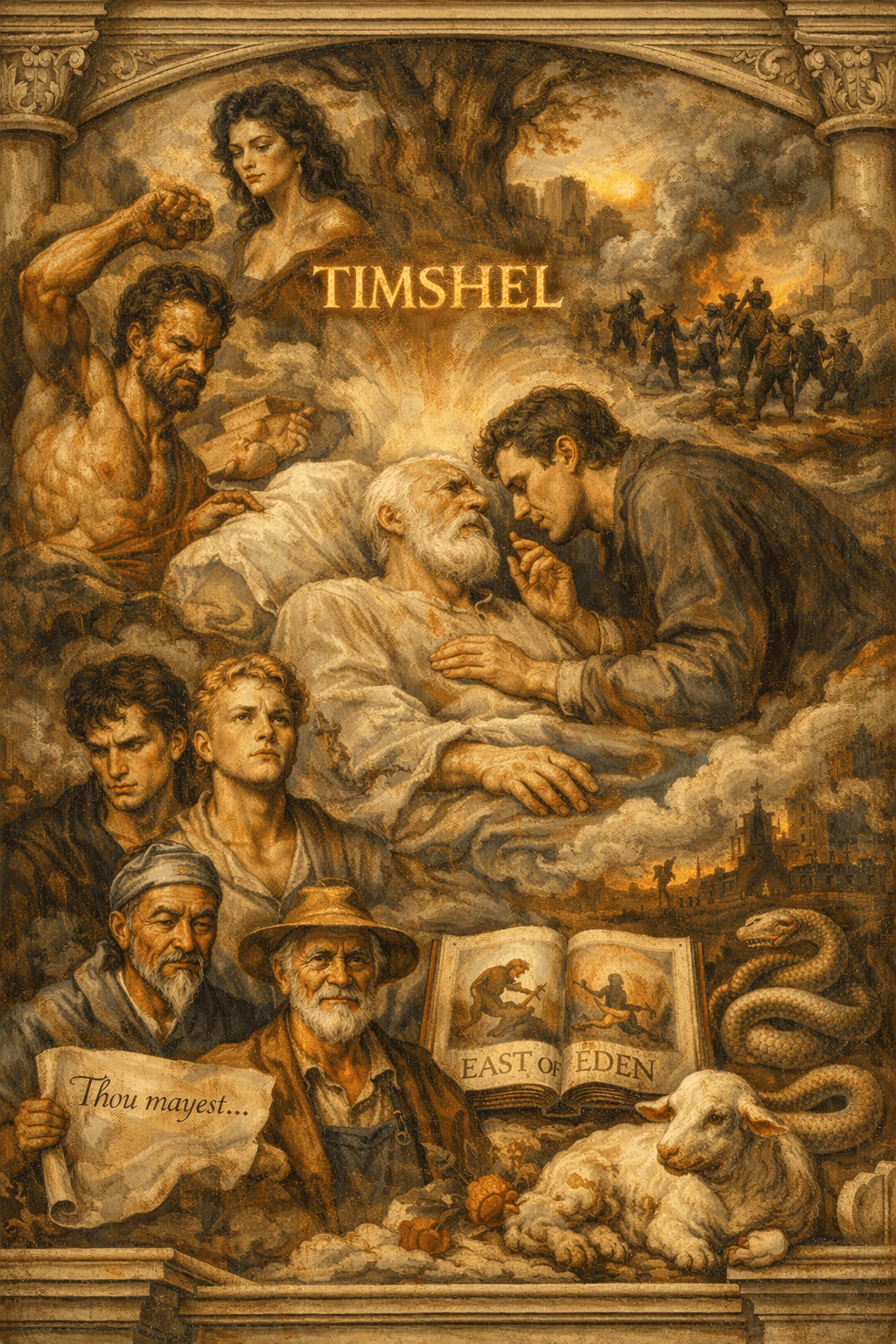
At the end, on Adam’s deathbed, the family’s old servant, Lee, insists that Adam perform one final act: a blessing. In his final moments, Adam speaks to Cal the Hebrew word “Timshel”—“Thou mayest.” It is a word heavy with significance: it is not absolution, nor is it condemnation. It is permission. It is an acknowledgment of human freedom and the moral responsibility that comes with it. Adam’s last word offers Cal—and, symbolically, all of humanity—the choice to overcome darkness, to act morally, and to embrace the struggle inherent in consciousness itself
A Parallel in Buddhist Thought
Although rooted in the Hebrew Bible, Steinbeck’s insight resonates with Buddhist philosophy. In Buddhist cosmology, the Human Realm occupies a precarious middle ground—between the instinct-bound Animal Realm and the pleasure-saturated Deva Realm.
Only the human condition contains sufficient suffering to provoke awakening and sufficient awareness to enact transformation.
The Dhammapada declares: “Attahi attano natho”—the self is the refuge of the self.
This is not a celebration of ego but an affirmation of agency. One’s liberation depends upon one’s own choices. Like Timshel, it asserts potential rather than predestination.
The Philosophical Implication: Freedom as Burden
Modern thought often treats freedom as entitlement. Steinbeck presents it as weight.
To say “Thou mayest” is to remove excuses. It denies fatalism. It denies deterministic despair. One may inherit temperament, trauma, and impulse—but one does not inherit conclusion.
Cal’s redemption lies not in erasing wrongdoing but in confronting it. The capacity to choose differently remains intact even after failure.
In this sense, Timshel is neither comforting nor severe. It is dignifying.
The Core Thesis
East of Eden advances a single claim: human beings are morally unfinished.
We are not angels, for we are divided. We are not beasts, for we are aware.
We exist in the unstable territory between impulse and intention. That instability is not weakness; it is the precondition of greatness.
Timshel means:
- You may transcend your resentment.
- You may govern your appetite.
- You may repair what you have broken.
- You may refuse to become what wounded you.
Not “you will.” Not “you must.” But “you may.”
Conclusion
Steinbeck believed there is only one story in the world: the struggle between good and evil within the human soul. Yet his enduring contribution lies in how that struggle is framed.
We are not trapped in a moral script. Nor are we guaranteed virtue. We stand, perpetually, at the threshold.
Animals cannot deliberate. Gods do not need to. Humans alone possess the terrifying privilege of choice.
The word Timshel does not promise salvation. It offers something more demanding:
Freedom.
And in that freedom—fragile, costly, irrevocable—lies the possibility of becoming.
- literature
- philosophy
- steinbeck
- east-of-eden
- timshel
Discussion
Loading comments…