Does Life Have a Purpose?
A short and simple look at why biology talks about purpose — and whether life itself really has one.
· 2 min read
Introduction
"Science can explain how we got here. Whether we are for something — that question moves beyond biology and into philosophy."
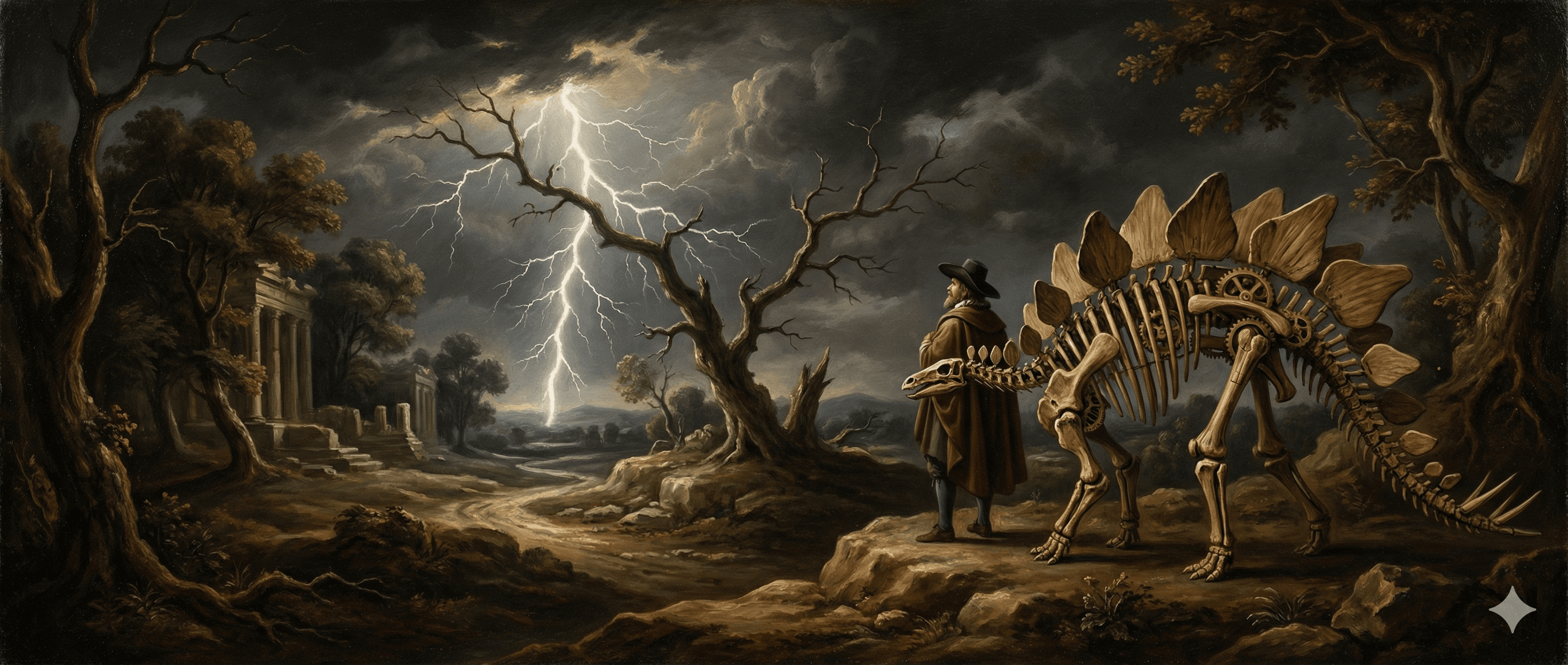
When biologists study a dinosaur like Stegosaurus, they ask: What were those big plates on its back for?
Defense? Attracting mates? Cooling the body?
This way of speaking—asking what something is for—is called teleology (from the Greek telos, meaning “end” or “purpose”).
But here’s the problem: We don’t think atoms or planets have purposes. So why do we talk as if living things do?
The Old Idea: Nature Has Goals
Ancient philosophers like Aristotle believed everything in nature had a goal.
- An acorn exists to become an oak.
- Eyes exist to see.
- Even stones fall because they “want” to reach their natural place.
This way of thinking lasted for centuries, painting a picture of a universe driven by built-in intention.
The Scientific Revolution: Nature as a Machine
In the 1600s, thinkers like René Descartes changed the picture.
Nature was no longer an organism with goals. It was a machine.
- Hearts are pumps.
- Bodies are mechanisms.
- Planets move because of physical laws—not purposes.
Science stopped asking why in terms of goals and started asking how in terms of mechanisms.
Darwin’s Big Shift
Then came Charles Darwin.
In On the Origin of Species, Darwin explained something crucial: Living things look designed—but they aren’t designed.
Through natural selection, helpful traits survive and spread. Over time, this creates the appearance of purpose.
Eyes are “for” seeing not because they were planned, but because creatures with better vision survived. So teleology in biology is a shortcut. It’s useful language. But underneath it is a mechanical process.
Does Evolution Itself Have a Goal?
Here’s the harder question:
Even if individual traits are explained by natural selection, does evolution itself move toward something? Toward intelligence? Toward humans?
Darwin wasn’t sure.
Some thinkers believed evolution naturally progresses upward—from simple life to humans. Others argued that evolution is just adaptation to local conditions, not a ladder toward perfection.
Big brains aren’t always better. Sometimes “running fast in a herd” works just fine.
There is no clear scientific evidence that evolution is aiming at anything.
So… Does Life Have a Purpose?
At the level of biology, parts have functions:
- A heart has a function.
- A wing has a function.
- Stegosaurus plates likely had a function.
But life itself?
Science doesn’t show that it has an ultimate goal. There’s no built-in cosmic destination. Living things aren’t “for” anything in a grand sense.
They simply are.
The Final Thought
We use purpose-language in biology because organisms are adaptive systems. It helps us explain how traits work.
But that doesn’t mean the universe has a master plan. The Stegosaurus plates had a function. The dinosaur itself did not have a destiny.
And as for us?
Science can explain how we got here. Whether we are for something—that question moves beyond biology and into philosophy.
And that debate is still open.
- philosophy
- biology
- evolution
- science
Discussion
Loading comments…